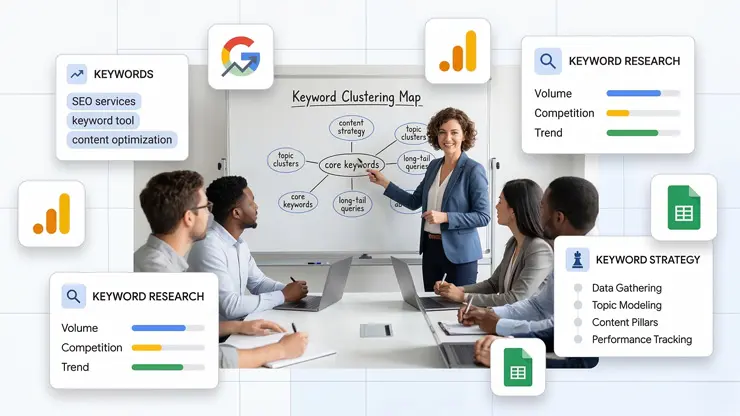
Maximize your search visibility by mastering advanced keyword clustering.
Keyword Clustering for Small Businesses
How to Build Topical Authority Without Keyword Stuffing
Keyword clustering is one of the most practical ways to turn scattered SEO work into a focused growth strategy. For small business owners, entrepreneurs, and marketers, the problem usually is not a lack of ideas. It is that pages get created one keyword at a time, with no larger structure behind them. That often leads to thin content, overlapping pages, weak internal alignment, and missed ranking opportunities.
Keyword clustering solves that by organizing related search terms into groups that belong on the same page or within the same topic area. Instead of chasing every phrase separately, you build pages around search intent, keyword relevance, and real customer questions. That helps your site feel more useful to users and more coherent to search engines. Keyword clustering also matters because search visibility is no longer just about putting a phrase on a page a certain number of times. Strong results come from topic depth, clear structure, trust signals, and content that reflects real experience. That is where better keyword strategy, stronger content planning, and high-quality backlinks work together.
Small businesses often waste time trying to rank a separate page for every variation they find during keyword research. That creates unnecessary complexity. A better approach is to group related terms, assign them to the right pages, and support those pages with solid on-page optimization, internal linking, and authority-building signals. This article explains how to do that in a way that supports traffic growth in the US market without falling into keyword stuffing or outdated SEO habits.
What Keyword Clustering Actually Does for SEO
At its core, keyword clustering is the process of grouping closely related search queries based on shared intent, topical similarity, or common ranking patterns. The idea is simple: not every keyword deserves its own page. Many queries are close enough in meaning that one strong page can rank for multiple terms at once.
That is important because search engines do not evaluate pages in the rigid way many site owners imagine. They are not just counting exact phrases. They are trying to understand whether a page is relevant, trustworthy, and useful for a topic. When your content is built around clusters instead of isolated phrases, it becomes easier to create pages with stronger topical coverage and better keyword relevance.
This also prevents one of the most common SEO problems: content cannibalization. If you publish multiple pages that all target very similar terms, you may end up competing with yourself. Instead of one strong page accumulating signals and authority, you get several weaker pages splitting clicks, links, and internal relevance.
A smart clustering model helps you decide:
which keywords belong on the same page
which topics deserve separate pages
which pages should act as pillar content
which supporting articles should link back to core pages
That is where clustering becomes more than an organizational trick. It becomes part of a real SEO strategy.
Why small businesses need clustering more than enterprise sites
Large brands can sometimes rank because they already have domain strength, established recognition, and a large footprint of indexed content. Small businesses usually do not have that luxury. They need every page to work harder.
When a small business publishes scattered content without a clear map, the site often ends up with:
Clustering fixes that by making content planning intentional. Instead of asking, “What keyword should we write about next?” the better question becomes, “What topic cluster are we trying to own, and which page in that cluster should rank for which type of intent?”
That shift changes everything. It improves content efficiency, reduces duplication, and helps the site accumulate authority around themes that matter to the business. For small business owners and marketers with limited time and budget, that is a major advantage.
Keyword clustering matters so much because it acts as the bridge between keyword research and execution.
The difference between keyword research and keyword strategy
A lot of teams stop at keyword research. They gather a list of phrases, volumes, and difficulty scores, then hand the spreadsheet to a writer. That is not a complete plan.
Keyword research tells you what people search for. Keyword strategy tells you what to do with that information.
A real keyword strategy answers questions like:
Which terms reflect commercial intent?
Which terms are informational but likely to lead into a service page later?
Which terms should be combined on one page?
Which terms deserve separate pages because the intent is clearly different?
Which pages should be strengthened with backlinks first?
Which terms are too similar to justify separate URLs?
This is why clustering matters so much. It acts as the bridge between keyword research and execution. Without it, content planning becomes reactive. With it, content becomes structured, scalable, and more aligned with both search behavior and business goals.
SERP-based grouping vs semantic grouping
Not all clusters are built the same way. Two common approaches are semantic grouping and SERP-based grouping.
Semantic grouping relies on the meaning of words. If terms sound similar, they get grouped together. That can be useful as a starting point, especially when organizing large lists quickly. But it has limits. Some phrases look similar while serving different intent. Other phrases look different while leading to nearly identical results.
SERP-based grouping is often more practical because it looks at what search engines already treat as related. If similar pages rank across multiple search terms, that is a signal that one page may be able to target the cluster successfully.
For example, a small business might assume “SEO consultant pricing” and “SEO consultant cost” should always be separate because the wording differs. In practice, the results may overlap enough that one page can satisfy both. On the other hand, two terms that sound close might deserve separate pages if the search results reveal different intent.
That is why the best clustering decisions are not purely linguistic. They are strategic. They consider search results, business goals, content type, and buyer intent together.
A recent guide from Keyword Insights leans heavily into that SERP-based view, and that is one reason it performs well. It frames clustering as a practical way to decide whether a single page or multiple pages are needed. That is useful, but small businesses should take it one step further: use clustering not just to organize keywords, but to build authority around a marketable topic set.
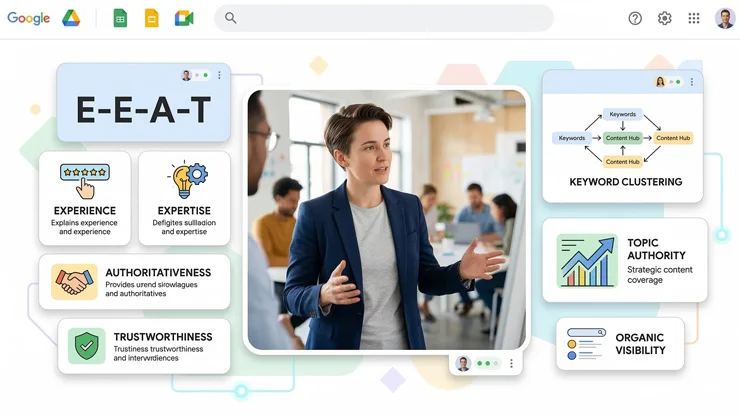
Learn how an SEO expert leverages E-E-A-T principles and strategic keyword clustering to build sustainable organic visibility.
E-E-A-T and why clustering supports it
E-E-A-T stands for experience, expertise, authoritativeness, and trustworthiness. While it is not a simple checklist, it reflects the broader quality expectations search systems and users have for content.
clustering supports E-E-A-T because it encourages depth instead of fragmentation. When your site covers a topic through a well-structured set of pages, it is easier to show real experience and expertise. Your main pages become stronger. Supporting content reinforces them. Internal links clarify relationships. Users see a site that actually knows the subject instead of one that publishes disconnected articles just to chase traffic.
This is especially important for small businesses trying to compete with larger brands. You may not have the biggest site, but you can build tighter relevance around your niche. A local service business, SaaS company, consultant, or e-commerce brand can still develop authority by owning a cluster thoroughly.
Authority is also strengthened when content is supported by credible off-page signals. That is where backlinks matter. High-quality links from relevant sources help search engines and users see your site as more established, which makes your core cluster pages more competitive over time.
Why keyword density is not the goal
Too many SEO articles still steer people toward outdated thinking about keyword density and keyword frequency. Those concepts are not useless, but they are often misunderstood.
Keyword density is simply the proportion of times a phrase appears compared with the total word count. Keyword frequency is the raw count of how often the term appears. Neither metric, by itself, tells you whether the page is good.
A page can have the “right” density and still be weak, repetitive, and unhelpful. Another page can use the main phrase less often and still rank because it satisfies intent better, covers the topic more thoroughly, and carries stronger trust signals.
The real danger is when people treat density as a target. That is how keyword stuffing starts. Writers begin forcing exact phrases into headings, repeating them awkwardly in body text, and creating copy that sounds mechanical. The result is content that may look optimized in a spreadsheet but performs poorly with actual humans.
clustering helps prevent that. Once you understand that one page can target several related terms naturally, you no longer feel pressure to hammer the same exact phrase over and over. The page can breathe. It can use supporting language, examples, subtopics, and related search concepts in a way that feels natural.
How clustering reduces keyword stuffing
Keyword stuffing usually happens when content is planned too narrowly. A writer is told to optimize a page for one phrase and turns that phrase into the center of every sentence. That is not strategy. That is over-optimization.
clustering creates a healthier framework. Instead of forcing one term endlessly, you build content around a topic family. That gives you room to discuss keyword research, search intent, backlinks, page structure, internal linking, authority signals, and conversion goals without sounding repetitive.
This matters for both rankings and readability. Search engines have become much better at understanding context, synonyms, and topical relationships. Users have also become quicker at spotting stiff, low-quality SEO copy. If your content reads like it was written to satisfy a formula instead of to answer a question, trust drops immediately.
A cluster-based approach keeps the writing natural while still making the page highly relevant. That is the balance modern SEO requires.
How to build a practical keyword clustering workflow
Most small businesses do not need a huge enterprise system. They need a repeatable process.
Start by gathering your keyword list. Pull terms from your preferred keyword research tools, customer FAQs, sales conversations, Google Search Console, internal site search, and competitor pages. The goal at this stage is breadth, not perfection.
Next, sort the terms by intent. Some are informational. Some are commercial. Some are transactional. Some are navigational. Intent is the first major filter because pages that serve different intent often should not be merged, even if the wording is similar.
Then look for clear topical overlap. Which terms are basically asking for the same answer? Which phrases would naturally belong on one page without making the page feel unfocused? Which phrases sound related but actually need separate pages because the user expects something different?
After that, assign page roles:
pillar page
supporting article
service page
product page
comparison page
FAQ or resource page
Once the cluster map is clear, create internal linking paths between related pages. This reinforces site structure and helps authority flow through the cluster instead of remaining isolated.
Finally, decide which pages deserve promotion and backlink support first. Not every page needs the same level of external authority. Usually, the best candidates are commercial pages or pillar pages that can pass value deeper into the cluster.
Where backlinks fit into a keyword cluster strategy
Backlinks are often treated as a separate discipline, but they work better when connected to content architecture.
A page supported by strong backlinks has a better chance of becoming the anchor of a cluster. Once that page ranks, it can send internal relevance and authority to supporting pages. That means links do not just help one URL. They can strengthen the broader topic structure of the site.
For small businesses, this matters because link budgets are limited. You want each acquired link to support something strategically important.
That is why a service like Lifetime Backlinks can fit naturally into a cluster-based SEO approach. Rather than thinking of backlinks as random wins, think of them as support for priority pages that anchor your keyword strategy. When those pages are already well-clustered and clearly aligned with search intent, backlinks become even more useful.
This also connects to brand trust. If your site is organized, your pages are relevant, and your authority signals are improving, your content becomes more competitive across a topic area instead of only around a single keyword.
The best way to get found is to be relevant across a broader range of topics, not just a handful of keywords.
Dharmesh Shah
A simple example of clustering for a small business
Imagine a small agency serving local businesses with SEO services. It could create separate pages for:
That is a good start, but clustering improves it further.
Instead of publishing scattered articles like “best keyword tools,” “what is keyword density,” “how many times should you use a keyword,” and “how to avoid keyword stuffing” as disconnected posts, those topics can be mapped into a stronger cluster.
A pillar article might focus on building a keyword strategy for small businesses. Supporting pieces could cover:
how to group keywords by intent
when similar phrases belong on one page
how to identify cannibalization
how backlinks strengthen important cluster pages
how to optimize content without keyword stuffing
That structure creates stronger topical authority than isolated posts ever could.
Using external trust signals wisely
For example, content from IntelliPlans on SEO strategies reinforces the idea that authority, engagement, and strong backlinks support long-term visibility rather than short-term gimmicks. That fits well with a clustering model built around relevance and trust.
Likewise, Find Me Directory’s small business growth article highlights discoverability and SEO-friendly business listings, which is relevant for smaller brands trying to strengthen presence beyond their own site. While directory listings are not a substitute for a content strategy, they can complement a broader visibility plan when they are reputable and relevant.
The important thing is restraint. Sources should support the article, not overwhelm it. One clear reference can do more than repeated mentions.
Common clustering mistakes to avoid
One mistake is creating clusters that are too broad. If a page tries to target every loosely related term in a niche, it becomes unfocused and weak. Clusters should be connected by genuine topical and intent overlap.
Another mistake is over-splitting. Some site owners create separate pages for tiny phrase variations that could easily live together. This wastes crawl equity, fragments authority, and creates avoidable cannibalization.
A third mistake is confusing content planning with optimization shortcuts. Clustering is not a trick for inserting more keywords into one page. It is a method for aligning content structure with the way users search and the way search engines interpret topics.
A fourth mistake is ignoring authority. Even the best cluster map still needs trust signals. If your content is thin, your site structure is messy, and your most important pages have no backlinks, the cluster will struggle to perform.
Expert SEO consultation featuring real-time data analysis from Google Analytics and Search Console to drive small business growth.
How to measure whether clustering is working
You do not need a complicated dashboard to know whether your cluster strategy is improving results. Start with a few practical indicators:
more total ranking keywords per page
fewer overlapping pages competing for the same terms
stronger impressions and clicks for core pages
better internal linking patterns
improved conversions from informational content into service or product pages
more stable rankings for topic groups rather than isolated phrases
You should also look at how pages support each other. A good cluster tends to create compounding effects. As one page improves, related pages often start gaining traction as well because the site becomes more coherent around the topic.
This is one reason clustering is so useful for businesses with limited resources. It helps each new page make the rest of the site stronger instead of just adding more content volume.
The strongest SEO pages are not the ones that repeat a phrase the most. They are the ones that stay most aligned with user needs.
Keyword relevance means the page actually fits the query, the subtopics, and the likely next questions a searcher will have. It also means the page belongs in the site architecture. A highly relevant page supported by related pages and strong backlinks will usually outperform a mechanically optimized page with no real authority behind it.
That is why small businesses should stop obsessing over density formulas and start thinking in terms of topical fit, trust, and structure. Clustering is a practical way to make that shift.
Final take
Small business SEO works best when it is structured, realistic, and tied to actual business goals. Keyword clustering gives you that structure. It helps you organize keyword research into a usable plan, reduce wasteful duplication, avoid keyword stuffing, and build pages that deserve to rank for more than one phrase.
It also fits naturally with modern SEO priorities. Good clusters support E-E-A-T by encouraging deeper topic coverage. They support better content planning by reducing random publishing. They support stronger link building because you know which pages matter most. And they support better user experience because your site becomes easier to understand and navigate.
If your current content strategy feels scattered, this is one of the best places to improve it. Start by grouping related terms with shared intent. Build stronger pages instead of more pages. Support those pages with internal links and quality backlinks. Over time, that creates something far more valuable than a pile of disconnected SEO content. It creates authority.
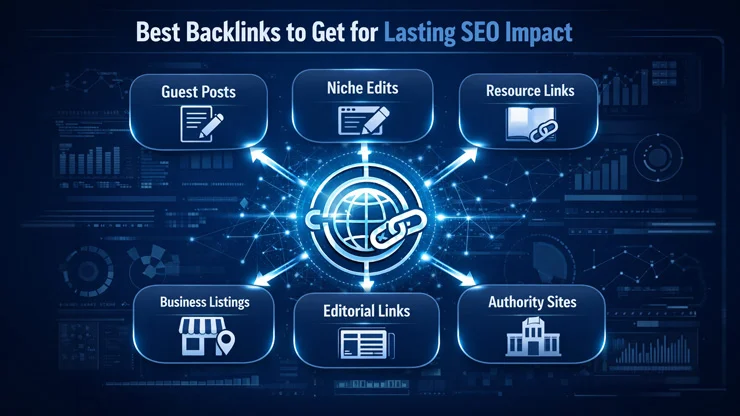
Boost your brand authority and organic growth today by exploring high-quality backlink options through Lifetime Backlinks.
About INTELLIPLANS
INTELLIPLANS empowers small businesses and nonprofits to bridge the gap between complex technology and meaningful growth. By specializing in high-performance digital solutions and operational strategy, we help mission-driven organizations build a dominant online presence while streamlining the systems behind the scenes.