

You can outpace bigger sites by leaning into long-tail keywords. These specific, often conversational searches match what real people type or say, which means higher intent, cleaner competition, and better conversions. Quick answer: long-tail keywords are precise, multi-word searches that align with intent, rank faster due to lower competition, and drive more qualified traffic—ideal for voice search, AI summaries, and local results in 2025 [1-3].
What Long Tail Keywords Are And Why They Matter
Clear definition of long tail keyword for blogs
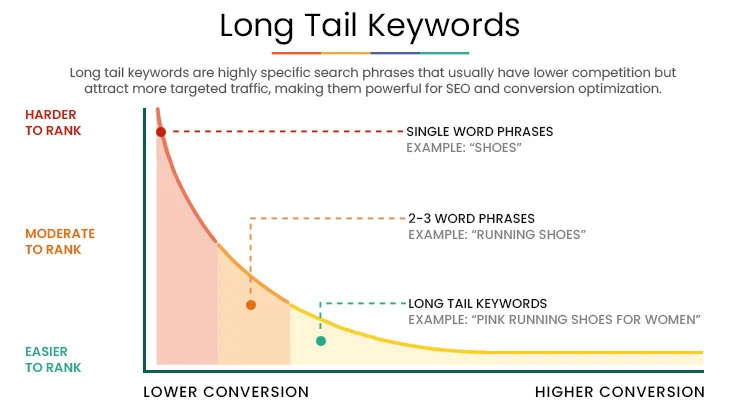
Long-tail keywords are specific multi-word phrases that reflect focused user intent, such as “best running shoes for flat feet under $100.” They tend to have lower individual search volume but stronger purchase or action intent. About 70% of searches fall into the long-tail bucket, so while each phrase is small, the aggregate demand is huge [1].
For blogs, this means you can write posts that speak directly to searchers’ needs. Instead of chasing a broad head term with vague intent, you meet people where they are—with the details they’ve already decided matter.
Why specificity boosts relevance and conversions
Specificity narrows ambiguity. When someone searches “best gluten-free pizza crust near me open late,” they’re not browsing—they’re choosing. Studies show long-tail queries earn higher CTRs than shorter terms, with 4–9 word phrases often above 30% CTR versus roughly half that for one-word terms [2]. Conversion rates also trend higher, commonly 3–8% better than broad terms because the content matches a precise need [3].
There’s a human factor here. People feel seen when content mirrors their situation. That boost in perceived fit translates into clicks and action.
Real world examples across US niches
Local services: “emergency plumber Chicago 24 hour” (decision-time intent).
Ecommerce: “carry-on suitcase under 7 lbs with USB port.”
Health & fitness: “low-impact HIIT workouts for bad knees at home.”
Food: “best dairy-free ice cream near me Portland.”
Education: “SAT practice schedule for last 30 days.”
Each reflects a clear context. The content that wins addresses that context straight away, then supports it with proof, steps, and helpful detail.
Long Tail vs Short Tail Keywords For Blog SEO
Key differences in intent volume and competition
Short-tail keywords are broad and high volume. They often attract mixed intent and fierce competition. Long-tail keywords are narrower, lower volume per term, and usually less competitive—making them easier to rank for while attracting qualified traffic [4]. Voice search growth pushes even more queries into the long-tail camp as people ask full questions in natural language [4].
When to target each type on your site
Short-tail: pillar or hub pages that define a core topic and build brand awareness.
Mid-tail: comprehensive guides that bridge broad interest and specific needs.
Long-tail: answer pages, comparisons, and “best for X” posts that convert.
Healthy sites blend the three. The pillar captures breadth. Supporting pages capture depth and intent, often within clusters.
Balance broad reach with targeted traffic
Think portfolio – long-tail keywords for targeted audiences. A small number of competitive targets can build authority over time, while a steady cadence of long-tail pieces compounds traffic and conversions quickly. AI-driven personalization and local search further reward specificity, so the balance tilts toward long-tail for most growing blogs in 2025 [5].
Find Long Tail Keyword Opportunities That Rank
Use keyword research tools and filters effectively
Modern tools surface long-tail patterns at scale. AI-enhanced platforms help identify emerging phrases and intent clusters with machine learning, which is especially useful for spotting topics before competitors pile in [6].
Filter by word count (3+), lower volume, and lower difficulty to find winnable terms.
Segment by intent: informational, commercial, transactional, and navigational [6].
Save clusters, not single terms, to build content maps.
Mine Google autocomplete PAA and related searches
Google’s autocomplete, People Also Ask, and related searches reveal language patterns and adjacent questions. These are grounded in real user behavior, which makes them perfect seed inputs for clusters and FAQs. Voice-style questions often appear here, and those map well to AEO-friendly answer blocks.
Analyze competitors and communities for gaps
Check which long-tail terms competitors rank for and where their content is thin. Then visit Reddit, Quora, and niche forums to hear how communities phrase problems. These phrasing nuances often reveal “hidden” long tails that tools miss, especially local or product-detail modifiers [6].
Build Keyword Clusters And Map To Search Intent
Group queries by informational and transactional needs
Group related queries around a unifying problem or goal. For example, a pillar on “home espresso setup” might include clusters like “best budget espresso grinders under $200,” “dialing in espresso for light roast,” and “how to descale Breville Barista Express.” Each cluster addresses distinct intent.
Decide dedicated page versus section coverage
Use intent, SERP depth, and query similarity to decide coverage. If the top results for a long-tail show standalone pages, create a dedicated article. If results blend into larger guides, cover as a section. The goal is clear topical focus without cannibalization.
Internal linking to support topical depth
Link from pillar to clusters to establish hierarchy.
Cross-link sibling long-tail pages that share sub-questions.
Use descriptive anchors that match intent, not exact-match stuffed phrases.
Thoughtful linking helps search engines and humans map your expertise. It also improves discovery and keeps people engaged longer.
Optimize Posts For AEO And SEO With Long Tail Terms
Write concise answers and expand with helpful details
Start with a 40–60 word direct answer near the top. Then expand with context, steps, examples, and evidence. This structure satisfies voice assistants and quick scanners while rewarding readers who want depth. Long-tail keywords shine here because they indicate which details matter most.
Place terms in titles headings alt text and URLs
Include the main long-tail in the title and H1 naturally.
Use variations in H2/H3s to capture supporting queries.
Keep URLs short but descriptive. Add helpful alt text that reflects image purpose.
Natural language beats rigid exact-match repetition. The aim is clarity, not density.
Add schema and media to earn rich results
Use FAQ, HowTo, and Article schema to signal structure. Add images, short clips, and step tables to make answers vivid. Search engines and AI systems surface content that’s easy to parse and visually helpful, which amplifies long-tail visibility in snippets and summaries [3].
There is no magical SEO formula for success. A reminder that long-term results come from quality work, not hacks.
Why Long-Tail Keywords Win In 2025 US Search
Match conversational queries for voice assistants
Voice prompts skew longer and more specific, like a natural back-and-forth. Long-tail content mirrors this, which boosts eligibility for voice answers and AEO placements. Over the past few years, this pattern has accelerated with smart speakers and on-the-go mobile queries [1,4].
Advantages of Long-Tail Keywords for Targeted Audiences
Long-tail keywords offer several key advantages that make them essential for effective SEO in 2025. They attract highly targeted traffic with clear intent, resulting in higher conversion rates and more engaged visitors. Because they face less competition, long-tail keywords enable faster ranking improvements, especially for smaller or niche sites looking to carve out authority. Additionally, their conversational nature aligns well with voice search and AI-driven queries, enhancing discoverability in evolving search environments .
Capture AI summaries and snippets with precise answers
AI-generated overviews and featured snippets gravitate to content that solves narrow questions cleanly. Long-tail pages, with tight answers and clear structure, get cited more readily in AI summaries because they map to the “sub-queries” systems fan out during synthesis [3,5].
Use local and near me modifiers for US audiences
“Near me,” neighborhood names, and ZIP code cues signal immediate, local intent. These long-tail modifiers often reduce competition to a hyperlocal set while increasing action rates. For community-focused blogs and small businesses, this is where long-tail keywords become a revenue engine.
Measure Results And Refine Your Keyword Strategy
Track rankings clicks and conversions in key tools
Monitor impressions, CTR, positions, and conversions in Google Search Console and analytics tools. Expect higher CTR on longer queries and use that signal to prioritize related content. AI-powered keyword tools can flag rising long-tails before volume catches up [6].
Monitor cannibalization and cluster coverage
Audit clusters quarterly. If two pages target overlapping long-tails and split impressions, consolidate or reframe one page. Add internal links where coverage is thin to clarify which page owns which intent.
Refresh content based on emerging queries
Update intros with new direct answers, expand sections reflecting new PAA questions, and add schema for FAQs that keep appearing. A light refresh, paired with a few new internal links, often unlocks fresh rankings for adjacent long-tails.
FAQs
What is the best example of a long-tail keyword?
A strong example pairs detail with intent. For instance, “best running shoes for flat feet under $100” shows budget, use case, and feature constraints—perfect signals for relevance and conversions [2-3].
What is an example of a long-tail?
“Emergency dentist open now in Dallas Saturday” is a classic. It’s time-bound, location-specific, and transactional, which tends to drive fast action.
What is the difference between long-tail and short tail keywords?
Short-tail terms are broad and high volume with mixed intent and heavy competition. Long-tail terms are specific, lower volume per query, and usually map to clearer intent, higher CTR, and better conversions [1-4].
What is a long-tail word?
It’s shorthand for a long-tail keyword: a multi-word search phrase with focused intent, often aligned with conversational or task-driven queries common in voice search and AI-assisted results [1,4].
Methodology and Sources
Claims and examples are based on recent industry research about long-tail prevalence, CTR behavior by query length, conversion trends for specific intent, and the growing role of voice and AI in search visibility. Where exact figures vary by study or tool, ranges are presented and framed for 2025 relevance.
Summary Takeaway
Long-tail keywords anchor a 2025 strategy that rewards clarity, intent, and helpful detail. Start with clusters, answer directly, and structure pages for AEO. Next steps: identify 5 clusters, publish one precise long-tail page per week, and refresh winners quarterly to ride emerging queries [1-6].
References
WP Creative. SEO Statistics for 2025. Accessed 2025. [1]
My Codeless Website. Keyword Research Statistics. Accessed 2025. [2]
DigiFlute. Mastering Long-Tail Keywords: The Essential Guide to SEO Success in 2025. Accessed 2025. [3]
Rank Math. Long-Tail vs. Short-Tail Keywords. Accessed 2025. [4]
Geeks for Growth. Long-tail vs short-tail: Which is best for your SEO strategy. Accessed 2025. [5]
BlogWidow; Decodehouse; Growett; Ricky Spears. Advanced and AI-powered keyword research techniques. Accessed 2025. [6]