


Introduction
Review count and star rating give Tallahassee businesses a solid baseline, and the next step is building on it with profile strengths that help you stand out.
Why review volume is only a baseline
Once your profile has a credible number of recent, genuine Google Reviews, adding more rarely separates you from competitors. Google’s own guidance points to relevance, distance, and prominence, and reviews are only one input to prominence. This is our interpretation, not a confirmed ranking formula.
Local Ranking Factors are the signals Google weighs when ordering Tallahassee businesses in the Map Pack, and understanding Tallahassee Map Pack ranking factors starts with three core ideas. Relevance, distance, and prominence lead the list, and reviews are only one part of prominence. Categories, services, and profile accuracy also shape where you appear. Because the Tallahassee Map Pack ranking factors play out differently from one neighborhood to the next, a business near Florida State University may compete on proximity, while one across town relies more on prominence and a complete, accurate profile.
Review enforcement is also stricter, which rewards businesses that follow the rules. By avoiding incentives and review gating, you keep your reviews in place and your listing in good standing.
What Google Business Profile optimization Tallahassee businesses need now
The effort you put in for 2027 should cover the whole profile, and for Tallahassee businesses that starts with local Google Business Profile optimization: accurate categories, fresh photos, complete service details, and steady review replies. Priority: High.
- Precise primary and secondary categories
- Complete services and products data
- Fresh, original photos, video, and posts
- Fast replies to calls, available messaging, and customer questions
- Website pages that match the profile
The sections below show how to prioritize each one for your market.
Local SEO is the framework that connects every profile lever in this plan. Categories, services, service areas, photos, and website pages all feed the relevance, distance, and prominence signals Google weighs for Tallahassee searches.
Why the Review-First Playbook Plateaus
Badge: Priority: Medium
Diminishing returns at competitive parity
The standard advice is simple: collect more reviews and protect your star rating. That works when a profile has almost none.
Review competition can vary considerably by trade in Tallahassee, but no verified local dataset in the material reviewed establishes a reliable review-count benchmark for each industry.
In a less competitive trade, a few dozen genuine reviews may be enough to match nearby businesses. In a crowded one, closing a substantial review gap can take time, and pairing review requests with other profile strengths helps you stand out.
What the evidence supports and what is interpretation
Some sources claim review velocity beats total count in most competitive scenarios. That claim comes without a cited study, so treat it as unverified.
Likewise, a Tallahassee agency page calls a complete, actively posted profile the biggest local-ranking factor. That is a vendor claim.
- Myth: A profile does not lose visibility after 30 dormant days.
- Interpretation: Past parity, profile completeness likely adds more than review count.
How Tallahassee Search Behavior Differs
Badge: Priority: High
University calendars and legislative sessions
Tallahassee demand follows the government and university calendar, and generic national tactics ignore it. Search volume for restaurants, housing services, and professional offices can shift with Florida State University and Florida A&M University terms, move-in weeks, and legislative session traffic.
These shifts are our interpretation of local patterns, not measured figures from the source material. Check your own Google Business Profile performance data to confirm them.
- Update hours before term breaks and session weeks.
- Post seasonal offers and service changes as they happen.
- Match photos to the audience you are seeking: students, state workers, or homeowners.
Midtown, Southwood, Thomasville Road and downtown searches
Searchers often name a neighborhood or corridor, so Local SEO performance in Google Maps depends on proximity and local relevance. A profile that accurately identifies the areas it serves helps customers understand where the business operates, which is why Tallahassee Google Business Profile service area setup matters. Listing neighborhoods and nearby districts you actually serve, from Midtown to the Thomasville Road corridor, does not by itself make your business rank in those locations. Keeping those areas consistent with your website and other local listings helps customers get accurate information, and the same goes for your business name, address, and phone number. Consistent NAP details across citations in Tallahassee directories, such as the Tallahassee Chamber of Commerce, Yelp, and local business listings, help customers find reliable contact information. Prioritize correcting wrong addresses, missing suite numbers, or outdated phone numbers; minor formatting differences are not proven local-ranking penalties.
LocalBusiness schema is structured data that tells search engines your business name, address, phone number, hours, and service areas. Add it to the website page that matches your Google Business Profile, and keep the business details accurate and consistent with the profile. This is our interpretation, not a confirmed ranking factor.
Action: Complete your Tallahassee Google Business Profile category and service area setup by choosing a precise primary category, adding relevant secondary ones, and listing service areas only where you truly serve customers. Then make sure your website accurately describes the areas you serve, including Midtown, Southwood, the Thomasville Road corridor, or downtown when relevant.
Effort: Low. Impact: Measurable through direction requests and calls.
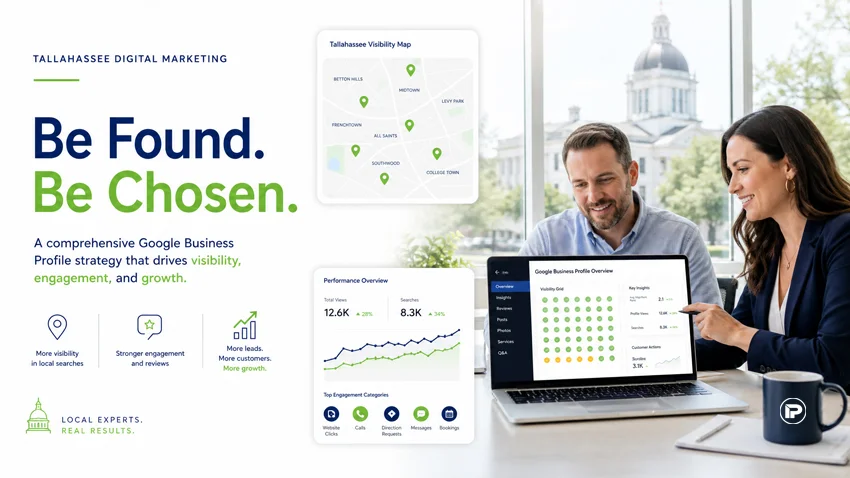
Tallahassee Google Maps local ranking factors, such as proximity, relevance, and prominence, shift with searcher location, so a single position check can mislead. Use heat map tracking to measure visibility on a local grid across Midtown, Southwood, and downtown, since a business may rank first near one neighborhood and disappear a few miles away. Then compare each area’s results against your calls and direction requests to see which ranking gaps cost you real customers.
The Google Maps 3-Pack often displays three local business listings in Tallahassee search results, and the Tallahassee local 3-Pack ranking competition is tight because only three businesses per search earn that visibility. Relevance, distance, and prominence decide who appears, and accurate categories and services help Google understand what your business offers; service-area settings describe where you operate rather than guaranteeing rankings there. In a market where nearby competitors often have similar ratings, those details can help customers understand which business best fits their needs, but they do not guarantee a 3-Pack position.
Higher-Leverage Profile Levers
Badge: Priority: High
Category and services precision
What it is: Your primary category, secondary categories, and a separate entry for every real service.
Why it matters: Categories and services tell Google what you do, which feeds relevance. Accurate, specific data helps you show up for the searches you want.
How to implement:
Business Categories are the labels that tell Google what your Tallahassee company does, and they shape which local searches you appear in. Tallahassee Google Business Profile primary category selection matters most: choose one primary category that most accurately describes your main business, since it helps Google match the profile to relevant searches. Google does not disclose an exact category-weighting formula. Then add secondary categories only for services you deliver.
- Pick the primary category that matches your main revenue source.
- Add secondary categories only for services you actually deliver.
- List each service separately with a plain description.
- Confirm hours and attributes are accurate.
Effort: Low. Impact: Measurable.
NAP Consistency means your business name, address, and phone number accurately represent the same business across your Google Business Profile, website, and local directories. For Tallahassee businesses, GBP local citation and NAP consistency go hand in hand: citations on Yelp, the Tallahassee Chamber of Commerce, and local data aggregators should have accurate, consistent business details. Audit listings for meaningful inaccuracies such as wrong addresses, missing suite numbers, and outdated phone numbers. Minor abbreviation differences alone are not an established ranking penalty.
Local Citations are mentions of your business name, address, and phone number on directories, chambers of commerce, and local sites. Keep their essential business details accurate and consistent with your Google Business Profile, and audit Tallahassee listings quarterly to catch outdated details.
Photos, video, posts and website alignment
What it is: Original photos, short video, regular posts, and website pages that match what the profile says.
Why it matters: Real visuals show customers the business is active. Matching pages give the profile consistent support.
How to implement: Upload real photos of your team, location, and finished work on a schedule. Post weekly, and link each profile service to a page that covers it.
Google Posts are short updates that appear directly on your Google Business Profile. Use them for seasonal offers, service changes, and events, such as FSU move-in weeks or legislative session hours. Keep each post accurate and tied to a real service.
Effort: Medium. Impact: Measurable through views, calls, and direction requests.
Responsiveness and Reframed Review Strategy
Badge: Priority: High
Messaging, calls and Q&A speed
Fast replies turn profile views into customers. A searcher comparing three Tallahassee options in Google Maps will often contact whoever answers first. That is our interpretation, not a confirmed ranking rule.
The Google Business Profile Q&A API was discontinued on November 3, 2025. Developers can no longer use it to read or post questions and answers. Businesses should instead keep their profile and website information accurate for customers using Google Maps’ newer AI-powered question features.
The Q&A Section of your Google Business Profile has been changing as Google shifts toward AI-powered answers in Maps. Where your Business Profile still offers access to existing questions, review and answer them accurately; do not assume you can seed new customer questions.
Gemini, Google’s AI assistant, is another place where profile data can surface. Accurate categories, services, hours, and policy-compliant reviews give Google consistent information to draw on, though this is our interpretation, not a confirmed rule.
AI Overviews are Google’s AI-generated summaries that can appear above traditional search results. For Tallahassee searches, they may draw on consistent business data across your profile and website. Keep categories, services, hours, and service areas accurate, though this is our interpretation, not a confirmed rule.
- Assign one person to check missed calls, available messaging, and customer questions each business day.
- Write short answers to the five questions customers ask most.
- Keep hours accurate so calls reach a person.
Effort: Low. Impact: Measurable through calls and, where available, message volume.
Policy-compliant requests and owner replies
Shift the goal of your Tallahassee Google review generation and reply system from more reviews to better ones, starting with safe review request wording for Tallahassee customers. Invite customers to share their honest experience, without directing them to mention specific services, staff members, or Tallahassee neighborhoods. Keep the request neutral and open-ended, and do not script the wording, offer rewards, or hint at the rating you hope to see. Details that customers choose to share can make their reviews more useful to readers and give your replies something specific to respond to, so every answer sounds personal rather than canned.
Note: Google’s policy calls for genuine, unincentivized reviews, so earning them authentically keeps your profile in good standing. Avoiding review gating, which means screening out unhappy customers before asking, also helps protect your reviews and your listing. The stakes go beyond Google, too: the FTC’s consumer review rule permits civil penalties for knowing violations of specified prohibited practices, such as fake reviews, incentives conditioned on positive or negative sentiment, and certain forms of review suppression. Asking every customer for honest feedback keeps your business on the right side of both Google and federal law.
Profile Suspension removes your Google Business Profile from Google Maps and search until Google reinstates it, so avoiding suspension is far easier than winning reinstatement. Inaccurate business details can trigger suspension, while fake or incentivized reviews and review gating can also lead to review removals or other profile restrictions. Keep requests neutral, and keep your information accurate and current. If your profile is suspended anyway, fix the underlying issue first, then submit a reinstatement request with proof of your business, such as a license, utility bill, or photos of your signage and storefront.
Fake Business Profiles are listings created for businesses that do not exist or do not operate at the stated address. They can push legitimate Tallahassee companies down in the Map Pack. Report them to Google, and keep your own profile accurate to avoid being mistaken for one.
- Send the direct review request to every customer, not a selected few.
- Reply to each review in plain language, and name the service when it fits naturally.
- Answer negative reviews calmly with a next step.
Effort: Medium. Impact: Measurable through review content and repeat inquiries.
SEO is about experience now, not tricks.
Review-First vs Balanced Profile Approach
Badge: Key Comparison
Cost, time to results, risk and measurability
The two approaches differ less in budget than in where the effort goes. The table below reflects our interpretation, not measured results from the source material.
| Factor | Review-First Approach | Balanced Profile Approach |
|---|---|---|
| Cost | Ongoing staff time for requests and follow-up | One-time setup effort, then a steady weekly routine |
| Time to results | Gradual, since reviews arrive one customer at a time | Faster to start, since profile edits are within your control |
| Risk | Higher if requests drift into incentives or review gating | Lower, since most work is accurate data and real content |
| Measurability | Review count is easy to see, but business impact is harder to link | Calls, messages, and direction requests can be tracked by lever |
Neither column promises a ranking. The balanced approach simply gives you more levers you can change and measure.
Action: Keep review requests running as a baseline, then move new effort to the levers above.
Ninety-Day Roadmap and Measurement
Badge: Priority: High
Audit, optimization and measurement phases
A fixed schedule keeps the work from stalling after the first week. Each phase ties to a business outcome: more qualified calls, messages, and direction requests.
- Weeks 1 to 2, audit: Check categories, services, hours, attributes, and photos against what the business actually does.
- Weeks 3 to 6, optimization: Fix the gaps, upload original photos, start weekly posts, and match each service to a website page.
- Weeks 7 to 12, measurement: Compare results to your week 1 baseline and adjust one lever at a time.
KPIs, call tracking and tagged links
Record a baseline before changing anything. Google Business Profile performance data shows profile views, direction requests, calls, and, where available, message interactions.
Business Profile Performance is the reporting area inside your Google Business Profile. Available metrics can include profile views, calls, website clicks, direction requests, message conversations for eligible businesses, and search terms. Download the performance report before changing anything, so your week 1 baseline stays fixed. Confirm available metrics in Google’s documentation, since Google updates this reporting.
- Use call tracking to separate profile calls from other sources.
- Add UTM tags to the website link so analytics shows profile visits and conversion actions.
- Log message volume and reply time each week, where messaging is available.
Next step: Reassess quarterly, since Google changes profile features and results are not guaranteed.
FAQ
Badge: Common Objections
But my competitor has more reviews. Should I catch up first?
Close a large gap only if your count is far below the businesses around you in the local pack. Past rough parity, more reviews are a baseline, not a differentiator. Compare your categories, services, photos, and response speed against that competitor, since those are changes you control directly.
Do reviews still matter?
Yes. Reviews remain part of how Google judges prominence, and customers read them before choosing. The argument here is about where new effort goes, not about abandoning review requests.
Google Reviews also carry legal and policy weight for Tallahassee businesses. Google’s Rating Manipulation Policy and the Federal Trade Commission (FTC) Consumer Review Rule both address deceptive review practices, but with different scope. Google prohibits incentivized reviews and selective solicitation; the FTC rule prohibits specified fake reviews, sentiment-conditioned incentives, and certain review-suppression practices. Keep every request neutral and open to all customers.
Keep asking every customer, follow Google policy, and reply to each review.
Does a profile lose visibility after 30 days without posts?
There is no documented automatic 30-day visibility penalty. Regular posts still show customers that the business is active, but they are not a penalty switch.
How do we know it works?
Compare Google Business Profile performance data at the end of week 12 against your week 1 baseline. Look at calls, direction requests, UTM-tagged website visits, and messages where available.
Local Service Ads are Google’s pay-per-lead listings that can appear above the Map Pack for eligible service businesses. They require screening and verification, and they run separately from your Google Business Profile. Treat them as a paid complement to the organic levers above, and track their leads apart from profile calls.
- Change one lever at a time.
- Log the date of each change.
- Review results against the baseline, not against a competitor.
Conclusion
Badge: Key Takeaway
Treat reviews as the floor, not the finish line. Accurate categories, complete services, original photos, fast replies, and matching web pages give you more to change and measure.
The review-first approach still fits a business with a thin review count next to local pack competitors. In that case, closing the gap comes first, within Google policy.
At INTELLIPLANS, we offer a structured GBP audit for businesses that want a baseline before changing anything. It is optional, and the checklist above works without it.
This reflects current conditions, so reassess as Google updates its features.